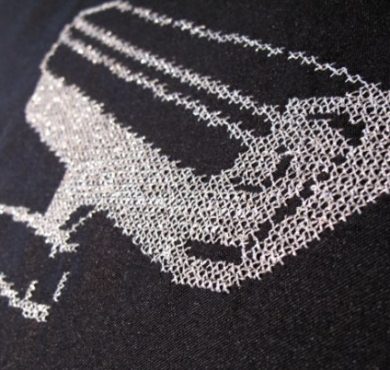
If you got your hands on a copy of the 2010 3CR Seeds of Dissent Calendar and flicked it open to everyone’s favourite consumerist month: December, this is what you’ll find:
Each of the contributing artists was asked to chose a theme and using our creative tools, discuss that issue in relation to the future. I chose an anti-consumerist/waste theme (obviously). And decided this was an opportunity to finally get around to stitching my sampler.
A sampler is something a learner stitcher is supposed to do. But it’s more than just about learning, it’s a kind of right of passage. And having now seen samplers from my own family, I have been keen to get into doing my own for a while.
This particular sampler is loosely based off the design of the sampler by Margaret Harper (1782) so it really is pretty old skool. But following on with an old tradition of subverting the ‘feminine arts’ the quote is not biblical, yet still rather moralistic and prescriptive.
We were also asked to provide a few words about what our piece was about. Here’s mine:
A Sampler For Our Times
In this time of global environmental and economic crisis the looming challenges can sometimes seem insurmountable, especially considering that Australia is the biggest carbon consuming country on our lovely planet.
While the challenge to turn this around may seem enormous it is not impossible to meet. One of the most important and effective changes we need to take on is our relationship with stuff. Indeed, it is our obsession with material things that is such a massive contributor to our environmental excesses.
There is an age-old saying, commonly heard during the last global depression, ‘Use it up, Wear it out, Make do, or Do without’. It sounds a bit dreary. But people who are relearning the skill of making things themselves can testify that when you MAKE culture rather than simply consuming it, life all of a sudden becomes a hell of a lot more interesting, revolutionary even.
This cross-stitched piece is a traditional sampler but with a modern twist. A sampler was a coming-of-age process for a young woman, especially during the 1800s. Samplers were employed not only to teach basic stitches for decoration and mending but also to learn basic literacy and numeracy skills, as well as a bit of healthy moralistic indoctrination. The quotes included were often biblical and always included some guiding doctrine to live by. Sometimes they were cheekily subversive. This piece hopes to continue that tradition.
You really need a copy of this Calendar on your wall next year! So get onto the website and grab a copy. Or even better, come to the launch at Readings Carlton on Friday the 13th of November at 6pm and pick up a copy and a nice glass of wine. And say hi to the artists and the great team that made this awesome calendar happen.
As for the original piece, I’m looking for somewhere to put it on display with the view to sell it to raise even more funds for 3CR. I’ve got a couple of options but I’m open to hearing other ideas. So if you have a brilliant wall in a shop, gallery, museum or whatever that you think would be just perfect to have this hanging on, get in touch.
Finally, and before you all ask, yes the pattern will be available for sale very soon. And of course, all proceeds go straight to 3CR – to keep Melbourne’s most radical radio, rad!

Everyone is welcome to come to the Calendar Launch on Friday, November 13 at Readings Bookshop in Carlton at 6pm for free wine and talk! [Readings is located at 309 Lygon St, Carlton, Victoria: Phone (03) 9347 6633.]
Face Up To The Future! with 3CR’s fifth Seeds Of Dissent Calendar. 3CR asked 12 artists who are part of Australian activist culture to contribute an artwork that reflects their idea of the future.
In 2006, 3CR created a Seeds of Dissent! Calendar to celebrate 3CR’s 30th birthday. The full colour, nationally distributed calendar teemed with radical dates, ideas and inspiration for social change. The calendar sold out of its 2000 copies. Since then 3CR’s Promotions Sub Committee’s Calendar Team has produced a yearly calendar, each with a fresh theme.
Face Up ToThe Future! — 3CR’s fifth Seeds Of Dissent Calendar — looks ahead to imagine a future we want to live in, while also celebrating Australia’s radical history. We asked 12 artists who are part of Australian activist culture to contribute an artwork that reflects their idea of the future. Some artists have created images that imagine the ideal future and some have chosen to depict issues we need to address today in order to achieve it.
Australian history re-envisioned with a cheeky female bushranger, uranium mining and the need to recognise the interdependence of ecology, the tyrannical expectations of female beauty, the return of tumbling as a form of transportation (!), Indigenous people at the heart of popular culture… these are the some of the issues explored by artists such as Arlene Texta Queen, Deborah Kelly, Bindi Cole, Adam Hill, Tom O’Hern, Mitch [? sorry Mitch], Jo Waite, Rayna Fahey (that would be me), Tom Civil, Mickie Quick, Lachlan Conn and Paul J Kalemba.
Cross-stitched samplers, stencils, felt pen drawings, collages, cartoons, illustration, computer art… these are the media the artists use to take us into the future of the 2010 Seeds of Dissent Calendar.

is a wonderful new book by some trouble-making bloke called Iain McIntyre, and is published by the redoubtable and not-at-all nervous Breakdown Press.
Launched in Newcastle at TINA it will be launched again, kicking and screaming, in Melbourne on THURSDAY the 5th NOVEMBER (remember, remember..) at the BELLA UNION BAR (Victorian Trades Hall, cnr Victoria and Lygon Streets) between the hours of 6 and 8pm.
The book compiles tales of unconventional political dissent included in three previously-published pamphlets — How To Make Trouble And Influence People (1996), How to Stop Whining and Start Living (1998) and Revenge Of The Troublemaker (2003) — and, as an EXTRA! ADDED! BONUS!, interviews with a number of pranksters, photos galore, and er, other stuff.
Thanks @ndy for the blog post which I just nicked and reposted here. There’s plenty of Radical Cross Stitch in BOTH these publications so make sure you get along to at least one of these great nights. And make sure you get your copy of the calendar! It does look fantastic. It’s a must have for your wall in 2010.
Hear ye all ye westside crafters!
My awesome clever friend Jo is running a series of FREE craft workshops in Braybrook, yes, Braybrook! I know! Exciting!
You should come. And bring your friends.
Hooray!
If you went into the city in the weekend, it’s quite likely you saw something a tad unusual. You may have seen a garden in a strange place, a performance that left you scratching your head or a group of people doing something a bit odd. Or you may not have even noticed at all as a group of silent people walked past you, experiencing the sounds of the city without making any of their own.
It was a fantastic weekend of interventions by all the artists involved in the Interventionist Guide to Melbourne. Did you see or hear anything over the weekend? I’d love to hear if you did.
As for the radical cross stitch component, there were two interventions over the weekend. The first was a cross stitch on an existing grid on Lonsdale Street, just near the corner of King Street. There is a beautiful old blue stone building there which is currently a barristers office, but in one of its manifestations was the home of the Seabrook Wine Merchants. Fittingly – at some point in time – a grape vine was planted outside the front and over the years has been trained up the side of the building. To help it along the way, a wire grid was attached to the side of the building.
This is what caught my eye.
During the G20 trials I spent a bit of time in this area and I noticed just how few children were around this part of town. During the week most of them are in school I realise but even small children are noticeably absent. And gee, try taking a pram through court security.. In the weekend this part of the city is a ghost town.
I decided this spot was perfect for a bit of commentary on the invivsibility of children in the urban space.
All the times I’d visited this space previously there wasn’t any greenery on the grape vine. The last time I went past there was a very small amount. So I was delighted to see how much had grown on it. The vine created a perfect frame for what I’d planned to do!
There’s a few more pics on our Facebook Page if you wanna check them out.
The next stage of operations was the Melbourne Bicycle Beautification Society Outing in Flinders Lane. Normally this is a site rich in bicycle basket bounty but Sunday there was very few. So rather than sit there and stitch baskets as they came and went, participants were armed with a zine including instructions, a needle, wool and a thank you tag and sent around the city to find baskets in other places.
Each zine kit had wool to make one of these
And one of these wee tags to say thank you to the owner of the bicycle for being a cyclist
Hopefully I get some more pics from participants over the next couple of days. Were you one of them? Where did you find your basket?
The zine with the instructions and all my thoughts about the issues of intervening in the city will be online for download soon. In the meantime I have a couple more kits with all the bits in them left to giveaway. If you’d like to win one just leave a comment below and tell me what are some of the things you think about when you’re walking through cities.
Overall, a wonderful weekend! Massive thanks and congratulations to Lynda for her brilliant curating. This has been a wonderful show to be a part of and I do hope we get to work together again soon.
So what are you doing on Sunday?
This weekend is the Interventionist Guide to Melbourne weekend of interventions. The artists will be out and about on the streets creatively intervening with the city. Or as the Craft Cartel blog puts it: an interactive artistic wake-up call to confront all that is predictable and boring in our city.
Initially I was gonna keep mine to sneaking about putting bits and pieces up in strange places for people to find. But I got convinced that it would be much more fun to do something where other people can join in.
So…
The Melbourne Bicycle Beautification Society in association with Radical Cross Stitch and the Interventionist Guide to Melbourne are on a pilgrimage to reward Melbourne’s cyclist for their contribution to leisure, saving the planet, looking good and stopping oil wars.
In an effort to encourage spontaneous and uncontrolled acts of creativity, we invite participants to learn the art of bicycle basket cross stitch.
Materials and instructions will be provided during this casual afternoon of direct action against the pervasive boring of everyday life.
Participants need only turn up to Flinders Lane near the corner of Degraves Lane any time from 2pm until about 4.
This free event is part of the Interventionist Guide to Melbourne intervention weekend. Artists will be out and about from the 17-18th of October encouraging and even inciting random acts of public creativity. For details on other artists and how to engage in their interventions visit http://interventionistguide.org
Not brought to you by any government department or arts funding organisation.
RSVP on Facebook
So a couple of weeks back I was travelling past the Barkly St fence and decided to jump off the bus to check out how the wool was weathering. And to my enourmously pleaseant surprise I discovered someone had added to it!
It’s not the best photo (I realised later) but it reads “I hear U’ stitched amongst the question marks! And it looked gorgeous!
Massive hellos and respect to the person who did it! Please get in touch xox
So in the weekend I headed back to get some better photos, only to discover someone had come along and cut it all off the fence. Not in any kind of nice way either, all the wool was left lying all over the ground. Hmpf.
So I cracked out some spray glue and stuck piles of it back to the top of the fence. Nowhere near as pretty. But better than it all sitting on the ground.
And still there’s no house there…
Last night saw the official launch of the Interventionist Guide to Melbourne cabinets in Platform Gallery, Flinders Subway, Melbourne. While there is a gallery space where you can go and see work, the true work is on the street, where each artist is spending the month of October encouraging and developing new ways of doing public art in Melbourne.
I have installed four pieces of work around the streets now and planning a fair few more. For those of you in Melbourne, put October 16-18 in your diary as the weekend where all the artists will be hitting the streets for performances, tours, installations and other creative bits and pieces.
Two of the four pieces have already been on here:
And here’s some pics of the latest couple.
You might recognise the last piece from here.
For this show us artists were asked to consider urban space: how it’s built, how we relate to it, how others relate to it. And for me it is very much about questions of ownership, access, power and control. My experiences of Melbourne’s CBD have been quite varied; as a worker, an activist, a resident, a mother, a pregnant woman, a public transport user, a cyclist, a pedestrian. None of those experiences have meant much control in the space so I’ve managed to experience quite varied forms of discrimination in that space.
I’m also very aware of the access issues other people face. Those in wheelchairs is a prime example. It’s hard enough getting around with a pram sometimes, but even harder with a wheel chair. You learn a whole different path of navigation around the city that able bodied people just don’t ever need to consider. Another example is the elderly. I do know people who live in Melbourne who haven’t visited the CBD in over a decade because it’s just too hard and intimidating. They prefer the relative safety of the suburbs where they can get everything they need without the (media driven) fear of the city space. And there’s of course other reasons, language especially.
This all means that there is a large amount of people who are simply excluded from that space, they are invisible.
I got wondering just how many other people thought about these issues and I figured probably not too many. Discrimination tends not to be something you think about until you experience it, and spatial experience is something that even those that experience it, aren’t necessarily aware of. The idea that our cities and buildings are designed by and for able-bodied white guys is such a given that considerations for other needs are rarely made.
I always find department stores pretty amazing in their design. If you stop and look at actually who uses a department store, women are by far the majority. Yet even their designs rarely accommodate their needs. If it’s a multi story building you will almost always find the baby wares department above or beyond ground level. So a woman with a pram is going to need to negotiate at least one floor change to get there. And given you aren’t supposed to use an escalator with a pram it can sometimes take longer to get to the department you want than to find the actual item you’re looking for once your there. And that’s if you can get through the aisles. It’s astonishing how many shops selling baby things I have been into with a pram that have aisles narrower than the average pram..
So a lot of the pieces I’m doing are talking about different peoples’ relationships with space. And also the stuff that moves through the space. Especially given a fair chunk of the urban space is dedicated to the peddling of stuff.
The piece above on the rubbish bin is one such piece. Very much geared towards encouraging people to consider how easily and flippantly we throw things away. Rather than focussing on whether you can recycle something or not, I’m more interested in people thinking about why they needed this throw away thing in the first place. It seems that so many people still believe that the solutions to climate change and the rampant abuse of our planet are decisions to be made by politicians and CEOs. While those people certainly have a role, the role of the consumer in changing their own behaviour is just as, if not more important. In a country with the highest per capita emissions in the world, we really need to start thinking about why we invest so much energy in making things just to have a short, uninteresting interaction with the thing and then throw it away. There’s got to more to life.
So these are just some of the issues that I think about when engaging with the urban fabric. And I am sure these are completely different to the issues the other artists consider. I urge you to visit the website and visit the gallery and check them all out.
And most importantly, I urge you to grab a map from the gallery and get out into the city and consider your own relationships with the spaces within and what opportunities you see for artistic practice and engagement. Then head back to the gallery and share your ideas with the rest of us!
And now for some pics of the opening. Thanks to all who came it was a great night!