Have you heard about this amazing new project? “In a war someone has to die” is an amazing new collaborative embroidery project by Hanne Bang.
From Hanne:
A couple of years ago I happened to zap by a TV program, in which a journalist was interviewing a professional African soldier. To the soldier`s great disappointment he was out of work at the moment – because there was no war in his region.
The interviewer asked the soldier if he was afraid of dying, and the soldier said: “No I am not afraid of dying. Are you afraid of dying?” The interviewer answered: “Yes I am afraid of dying”. Then the soldier said, without any sentimentality: “In a war someone has to die”.
This little dialogue, and the words “In a war someone has to die”, returned to me over and over again. Of course I knew that in wars people die, but suddenly I saw the essence of war and the reality of it very clearly.
These words are the main element in the art project. I use this sentence – these harsh words – in a feminine expression, as handkerchiefs and embroidery are.
You can participate in this project by visiting the website or the facebook page. I can’t wait to see the finished result!
I’ve been promising new patterns for a while and here’s the first of a new bunch.
This design is getting back to some old school roots with a lovely redwork antique border. And a quote from one f my favourite films of all time, The Edukators. This quote was sprayed on a wall in the film and I love it!
And I have a guest stitcher for this pattern, the adorably ace Curegreed who you may also know from her guest blogging at Mr X Stitch about her studies at the Royal School of Needlework (for which I am INSANELY jealous). We met last year at a Craft Cartel crafternoon when she was visiting these fair shores for a wedding. And I’m so excited to be doing more work together.
You can buy it in the Radical Rags store for a special intro price of only $5, score!

Further to the rad things in the last post is this awesome new group that’s just popped out of Adelaide. So if you live in the crazy hot city – check out Radical Craft Adelaide.
They’ve been holding some crafternoons. Next one is on Dec 12 for those who want to stitch and bitch radically. It’s gold coin and funds go to ActNow Theatre for Social Change. Bring along your current project or they’ve got cross stitch kits on hand for a few dollars. RSVP and check out all the details on Facebook.
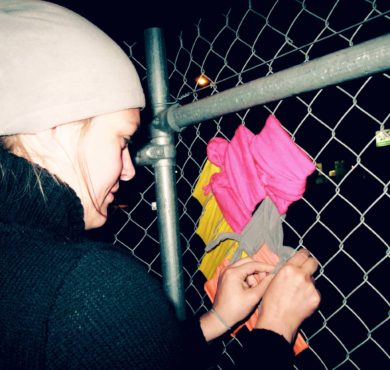
So a couple of weeks back I was travelling past the Barkly St fence and decided to jump off the bus to check out how the wool was weathering. And to my enourmously pleaseant surprise I discovered someone had added to it!
It’s not the best photo (I realised later) but it reads “I hear U’ stitched amongst the question marks! And it looked gorgeous!
Massive hellos and respect to the person who did it! Please get in touch xox
So in the weekend I headed back to get some better photos, only to discover someone had come along and cut it all off the fence. Not in any kind of nice way either, all the wool was left lying all over the ground. Hmpf.
So I cracked out some spray glue and stuck piles of it back to the top of the fence. Nowhere near as pretty. But better than it all sitting on the ground.
And still there’s no house there…
Last night saw the official launch of the Interventionist Guide to Melbourne cabinets in Platform Gallery, Flinders Subway, Melbourne. While there is a gallery space where you can go and see work, the true work is on the street, where each artist is spending the month of October encouraging and developing new ways of doing public art in Melbourne.
I have installed four pieces of work around the streets now and planning a fair few more. For those of you in Melbourne, put October 16-18 in your diary as the weekend where all the artists will be hitting the streets for performances, tours, installations and other creative bits and pieces.
Two of the four pieces have already been on here:
And here’s some pics of the latest couple.
You might recognise the last piece from here.
For this show us artists were asked to consider urban space: how it’s built, how we relate to it, how others relate to it. And for me it is very much about questions of ownership, access, power and control. My experiences of Melbourne’s CBD have been quite varied; as a worker, an activist, a resident, a mother, a pregnant woman, a public transport user, a cyclist, a pedestrian. None of those experiences have meant much control in the space so I’ve managed to experience quite varied forms of discrimination in that space.
I’m also very aware of the access issues other people face. Those in wheelchairs is a prime example. It’s hard enough getting around with a pram sometimes, but even harder with a wheel chair. You learn a whole different path of navigation around the city that able bodied people just don’t ever need to consider. Another example is the elderly. I do know people who live in Melbourne who haven’t visited the CBD in over a decade because it’s just too hard and intimidating. They prefer the relative safety of the suburbs where they can get everything they need without the (media driven) fear of the city space. And there’s of course other reasons, language especially.
This all means that there is a large amount of people who are simply excluded from that space, they are invisible.
I got wondering just how many other people thought about these issues and I figured probably not too many. Discrimination tends not to be something you think about until you experience it, and spatial experience is something that even those that experience it, aren’t necessarily aware of. The idea that our cities and buildings are designed by and for able-bodied white guys is such a given that considerations for other needs are rarely made.
I always find department stores pretty amazing in their design. If you stop and look at actually who uses a department store, women are by far the majority. Yet even their designs rarely accommodate their needs. If it’s a multi story building you will almost always find the baby wares department above or beyond ground level. So a woman with a pram is going to need to negotiate at least one floor change to get there. And given you aren’t supposed to use an escalator with a pram it can sometimes take longer to get to the department you want than to find the actual item you’re looking for once your there. And that’s if you can get through the aisles. It’s astonishing how many shops selling baby things I have been into with a pram that have aisles narrower than the average pram..
So a lot of the pieces I’m doing are talking about different peoples’ relationships with space. And also the stuff that moves through the space. Especially given a fair chunk of the urban space is dedicated to the peddling of stuff.
The piece above on the rubbish bin is one such piece. Very much geared towards encouraging people to consider how easily and flippantly we throw things away. Rather than focussing on whether you can recycle something or not, I’m more interested in people thinking about why they needed this throw away thing in the first place. It seems that so many people still believe that the solutions to climate change and the rampant abuse of our planet are decisions to be made by politicians and CEOs. While those people certainly have a role, the role of the consumer in changing their own behaviour is just as, if not more important. In a country with the highest per capita emissions in the world, we really need to start thinking about why we invest so much energy in making things just to have a short, uninteresting interaction with the thing and then throw it away. There’s got to more to life.
So these are just some of the issues that I think about when engaging with the urban fabric. And I am sure these are completely different to the issues the other artists consider. I urge you to visit the website and visit the gallery and check them all out.
And most importantly, I urge you to grab a map from the gallery and get out into the city and consider your own relationships with the spaces within and what opportunities you see for artistic practice and engagement. Then head back to the gallery and share your ideas with the rest of us!
And now for some pics of the opening. Thanks to all who came it was a great night!
The latest Melbourne Revolutionary Craft Circle action already got in the local paper. And to add to that I did an interview on 3CR’s fabulously awesome DIY Arts Show – which you can listen to online now.
AND today a story has appeared in The Vine about it.
Yay!

After the latest action by the Melbourne Revolutionary Craft Circle in Footscray, one of the local papers, The Star, wrote a story about it. Including a lovely bad ass guerilla crafter pic!
Readers of Radical Cross Stitch will remember last year when the Melbourne Revolutionary Craft Circle got out in Footscray and stitched ‘I Wanna Live Here’ on the fence on the corner of Barkly St and Commercial Road. Here’s the award-winning short film by Anna Brownfield as a refresher
So almost a year on and some philistine (guessing the landlord..) cut it off! Clearly not happy with the community questioning the ongoing waste of such a precious resource the local landmark was destroyed.
The MRCC was clearly not going to let this go unresponded to. So a few days later we were out again, this time armed with bright green wool and tummies filled with Pho.
What the hell is going on?
Why is this block still empty?
Why are there 11 other vacant sites around the primary school?
Why does the State Government continue to believe the outright lies of the property industry that the housing crisis is driven by lack of land?
Why do we still allow this waste of our most precious resource when there’s over 100,000 people every night in Australia with no place to live, let alone call home?
We’ve had enough.
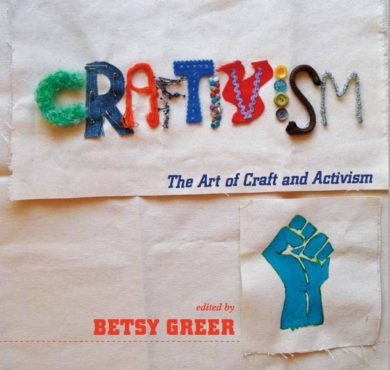
The long-awaited Episode #8 of the Craft Cartel podcast, and we talk to Betsy Greer whom we all know and love from craftivism.com abut her new book ‘Knitting for Good: A guide to creating personal, social and political change, stitch by stitch.

Betsy has a great big long chat with Rayna about her new book, consciousness in the craft world and Paris Hilton. Yip, Paris Hilton. You have to listen to hear what that’s about. The three links as discussed in the interview are: d.d.i.y. don’t do it yourself by Lisa Anne Auerbach from the Journal of Aesthetics and Protest. The Story of Stuff The Gas Station Project by Jennifer Marsh And you can win a copy of the book! Just send the answer to the question in the podcast by March 31 to go in the draw to get your own copy of this gorgeous book. And as always we’d love to hear from you, comment below or drop us a line. And don’t forget to check out the archive if you’re new round here.
If that doesn’t work (and it might not, we’re still having issues with the plugin that runs these things…) you can download the file directly from here.
We really don’t like advertising very much round these parts, so if you like what you hear, please make a donation to help support future episodes. It’s what an add-free world sounds like.

I’m re-reading bell hooks’ Feminist theory: from margin to center right now, hence this small portrait of her. I’m thinking about removing it from the frame & making it into a patch to put on a t-shirt instead (just have to find a suitable tee).
For those of you that don’t know, bell hooks (or Gloria Jean Watkins, which is her real name) is an American writer, feminist & scholar that deals with the relationship between sexism, racism & class. I like they way she challenges the contemporary idea of feminism as a movement & an expression that could mean just anything, depending on who defines it. According to hooks, feminism must be “the struggle to end sexist oppression” & that means that the dominant liberal feminism of today, that doesn’t deal with class issues, can never be real feminism. She is relentless in her assault on white, middle class feminists (hey, that’s me!) & the movements unwillingness to acknowledge & analyze it’s own racism & class issues. But at the same time as she advocates a raging criticism against how white feminists have excluded & marginalized black women or other ethnic groups & made their own strive for equality with privileged white men the goal, she’s very clear on what has to be done: a turn towards companionship, solidarity & bonding between women (a bond that does not have it’s roots in an imagined shared role as “victim” or “oppressed”, but in shared strength & resources). She’s even written a book that is all about love. I’d really recommend reading bell hooks to anyone who’s interested in the ways that sexist, racist & class oppression works together & has to be challenged together.
Cross posted from cross yr stitches.